Corcoran Holt on tough love, spiritual connection and finding the ‘Freedom of Art’
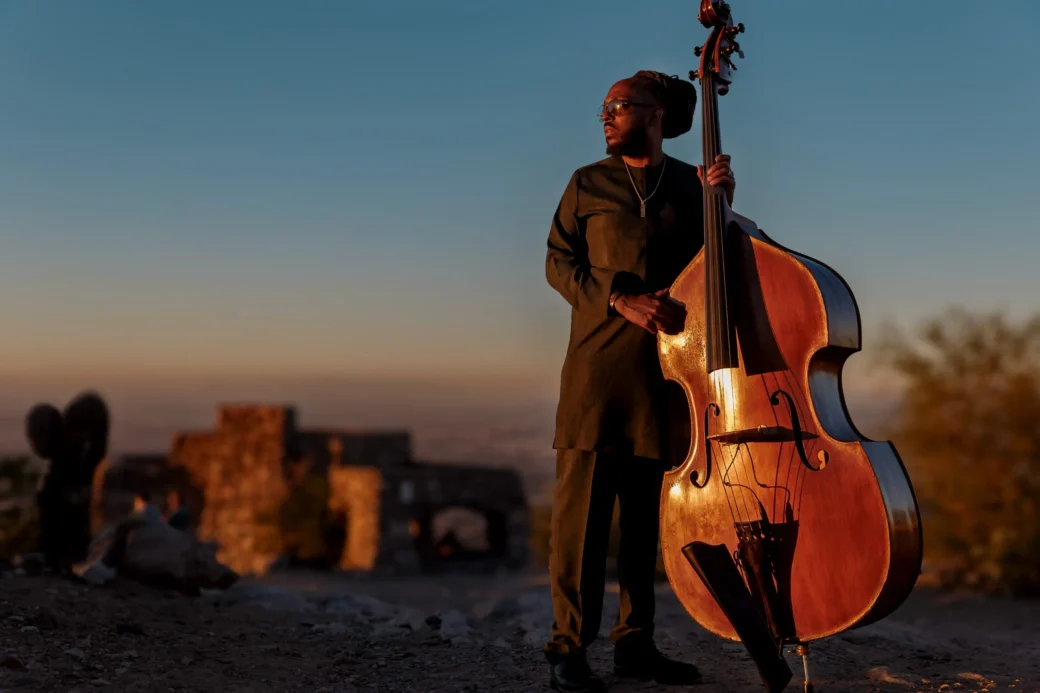
It is of course impossible to predict whether Corcoran Holt’s new release, Freedom of Art, will end up representing his creative apex, when all is said and done. But what’s clear is that this record — released last month via Holt House Records — represents a period of maturity, and positions the D.C.-born, Phoenix-based bassist and composer as both an heir to a legendary genealogy and a mentor to the next generation.
After many years in New York (and an 18-month detour back home to D.C.), Holt recently transitioned to Arizona, where he currently serves as assistant professor of jazz bass at Arizona State University. Freedom of Art marks these transitions, featuring a sound honed in the bands and lineages of early 2000s jazz. Just as important, if not more so, it is also a sound that reflects Holt’s own cultural and familial connection to the core of Black American Music. If nothing else, this album is the latest dispatch from a proud lineage of D.C. bassists who have made indelible marks on the world of improvised music.
This week, Holt brings those lessons and sounds back home to Blues Alley, where he will perform on Friday night in celebration of Freedom of Art’s release. Ahead of the show, I spoke with Holt on WPFW 89.3 FM during “Jazz Stories,” the Thursday-afternoon show that I co-host with CB’s Gio Russonello.
This interview has been edited for length and clarity.
CapitalBop: One of the first tracks on Freedom of Art is “Transition Blues.” One of the wonderful things about the blues is that they continue to offer us so much. What is your thinking about the blues, and how did that inform the background for the rest of the record?
Corcoran Holt: The blues is first and foremost a feeling of expression. It has been created into a form, a genre of music. And it’s also part of the backbone of the music we call “jazz.” The blues is a vehicle used in music to tell a story, for one to be able to translate exactly how they’re feeling in the moment.
This particular song is capturing the movement that I experienced in moving from New York City, back to Washington, D.C., and then on to Phoenix, Ariz., where I’m currently teaching. There’s been a lot of wonderful feelings that have gone into making those moves between these three cities in the last few years. If you listen to that tune, you can hear that it sounds like we’re on the move — it’s up-tempo, there’s some things that are expected in there, and there’s some things that aren’t expected.
My version of the “Transition Blues” is the emotion of movement, of transition, of change. Going from New York to D.C., being an artist, being a musician, also having a family, and taking my family to three different cities — it’s very involved, it takes a lot of energy. So that’s that energy behind this. You can imagine flights, going through the airport, landing in a certain city, trying to just get set up, trying to get adjusted. So this tune is about adjustment, transition and evolution.
CB: That tracks with the history of the blues. Blues people were always on the move — when you couldn’t take anything else, you could take your guitar and you could bring the stories of that journey to the next destination. In that respect, can you talk a little bit about the evolution of your work? Looking back, how have the people you played with shaped your sound?
CH: I’ve been blessed from a young age. I came up in D.C. and attended Duke Ellington School of the Arts. After I graduated in 2000, I went on to study at Shenandoah University. During that time period, I was studying with a great bassist in Michael Bowie, who gave me an opportunity to play with the Curtis Fuller Sextet. Curtis Fuller is a great trombonist — well known for playing in Art Blakey’s Jazz Messengers, and playing trombone on John Coltrane’s Blue Train. I was very young, about 20 years old, and I was put on that gig at Blues Alley, playing with this amazing band. So I was around elder musicians from a young age — pioneers of the music.
From that point, I was playing with Curtis. I moved to New York in 2004, and fell into the scene right away.
I’m sitting at home one day, around 2006, and I get a phone call. I pick up the phone, and it’s Kenny Garrett. He said, “This is Kenny Garrett. I don’t know how I got your number, exactly, but I was told to give you a call. I have a tour coming up. Are you available?” And I was nervous. I was just getting situated in New York, and I’m like, “Man — I’m getting calls from Kenny Garrett!”
Kenny asked me, “Do you know my music?” My answer was an honest answer. I said, “I don’t know all of your music, but I know some of your music. I could learn the music.” He said, “We’re leaving next next week. Can you play something for me?” So I played something for him over the phone, and he said, “All right, cool. I’m going to have my manager call you in a few minutes.” But then Kenny calls me back instead of his manager. And he says, “Corcoran, thank you, but we’re going to go with somebody that knows my music.”
I felt crazy because I was like, “I told him that I didn’t know his music, and I probably ruined an opportunity.”
But what I had to think about at the same time was that I had just gotten to New York, and I had a lot that I needed to do. I had a lot of playing that I needed to do. At that time, I was still playing with Curtis Fuller off and on. I had started doing sub work with the Heath Brothers, so I was getting the information from a lot of the older legends. But when I got that call from Kenny, I felt kind of crazy — like I blew this opportunity.
Fast forward to 2011, I get another call from Kenny Garrett. “This is Kenny Garrett. A friend of yours, Benito Gonzalez, plays in my band. We’re looking for a bass player to join the tour.”
He said, “Do you know my music?” I said, “Yes, sir, I know your music.” I did not know all of his music, but at that point, I felt like I had more experience, and this beautiful opportunity came around again. So I went over his house. We played, it was cool, and we went on tour.
I have been playing with him ever since. I was a regular in the band for 13 years. I still play with him off and on, but due to life and different responsibilities, I had to step away. But it was, and still is, amazing. Kenny is deeply into spirituality, and he respects and has love for the ancestors. It’s the same with me. I really believe that a lot of the blessings that I have, I have because these ancestors are watching over me.
CB: Robert Glasper recently shared his own reflection, echoing a similar Kenny Garrett story. Young musicians today don’t necessarily experience that kind of trial by fire. And I’m wondering what that leaves out, not going through that. Because there are multiple ways of bringing younger players up, whether the trial-by-fire approach or the more closely watched, careful, patient mentorship model. As you are now stepping into the role of the mentor to other young players, how are you passing those lessons on?
CH: I think both sides are extremely important. I always welcomed being uncomfortable — I always just wanted to be better. I look forward to waking up every day and being a better bass player, being a better person, having a better understanding of what I’m doing.
Another event reminds me of that. I was also very young, and it was actually the Curtis Fuller gig at Blues Alley — my very first big gig, that Michael Bowie subbed to me. I showed up — you know, I was prepared, man. I felt like I learned all the music, and I had all the Curtis Fuller tunes in front of me. At first, I was doing pretty well. Then all of a sudden, an audible was pulled in the middle of the show. Curtis said, “Now we’re going to feature our trumpet player, Mr. Wallace Roney, in the selection of his choice — a ballad.” And I was like, “Okay, uh oh. I wonder if it’s something in the book?” Then they called “‘Round Midnight,” the Miles Davis version, because Wallace Roney was a protege of Miles’s.
At that point, I was very young — 19, 20 years old. I learned “‘Round Midnight” from the Real Book, but you should learn stuff from the recording and then from playing it. So I had to learn it right there.
I remember, my mom was in the audience. The air conditioner was blasting in Blues Alley. They called that tune. They kicked it off. Man, they started the intro, and I didn’t know it! I just fell apart. I’m sweating bullets, the AC’s blasting, and I’m looking down. Wallace takes a solo. I’m lost during the form. I’m just all over the place.
This is the information being passed down from one generation to the next.
Man, I felt terrible. And he looks at me, and he just sucks his teeth a little bit and walks off the stage. So that sat with me. Being young, I felt embarrassed. But you can’t know everything, and I tell this to my students now: Sometimes you have to learn on the spot.
So, after the show, I was kind of just standing there. John Hicks was at the piano. John Hicks looks at me. He says, “Young blood, come over here. Sit down. Sit right here next to me.” So I sit next to him on the piano. He starts playing the intro, very slow. Plays through all the changes, very slow. He said, “Did you hear that?” I said, “Can you do it one more time?”
He showed it to me. He showed me the tune. And we’re talking about John Hicks — a master pianist. This is the information being passed down from one generation to the next.
I needed that. I needed to feel that feeling that I got from butchering that tune under a living legend such as Wallace Roney, but then having another living legend such as John Hicks show it to me meant everything.
It was a mixture between tough love and feeling embarrassed, which was needed. I needed to feel that. I needed to know that I wasn’t correct. We can’t act like I could butcher a song underneath somebody and be like, “Oh, that’s cool.” No — I’m on the stage with Curtis Fuller, John Hicks, Carl Allen, Javon Jackson and Wallace Roney. And if I’m there, there’s a reason, and I needed to live up to that.
There has to be two sides. You have people that are giving, that are warm-hearted. And you have people that tell you that you need to get your stuff together. That’s how it is, and that’s how it’s always been done. You get embarrassed, and you come back and you do your best. And I was hired again the next year, once they came back, and then that was the jumpstart of my career.
CB: Freedom of Art features Kweku Sumbry playing djembe as a central voice. What was your thinking about including djembe as a major percussive force on the record?
CH: Kweku and I share a history. I started on djembe when I was four years old, and Kweku’s uncle was my djembe teacher. I actually remember when Kweku’s mother was pregnant with him. I remember when he was a baby, when he was little, when he first started drumming. And Kweku is incredible. He’s special. We come from the same community in D.C. Our families are very close — our strong, Afrocentric community that we both grew up in.
One thing that Kweku has is, he plays the drumset in a unique way. He brings the African influence, the straight-ahead influence, world music, go-go music. He has it all, and he’s been able to find a way to connect his drumming on a drum set with what he does on the djembe. What better way to show freedom than the sound of a djembe soaring over top?
I am just thankful to have been able to have that spirit on this recording. The djembe is very dear to me — it’s my spiritual connection to the music, and I needed to have that sound.