Deep Groove: ‘The In Crowd’
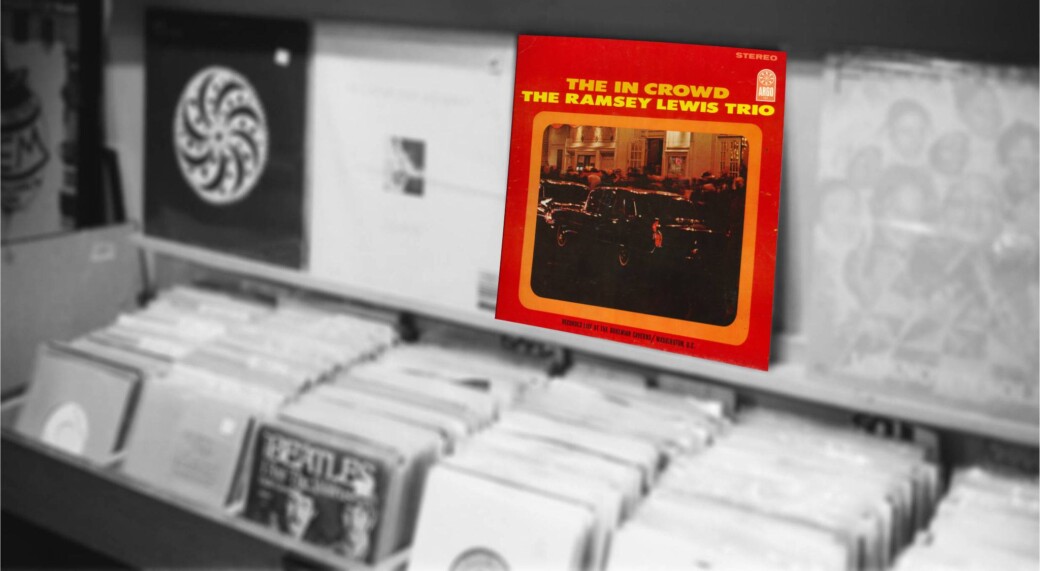
The In Crowd’s cover features an image of people lined up on the street. And if this was indeed a photograph taken outside U Street’s iconic Bohemian Caverns on one of the nights The Ramsey Lewis Trio recorded The In Crowd, then it may indeed be welcome nostalgia for a time when improvised music was a popular nighttime affair in the District.
Longtime radio host and jazz historian Rusty Hassan often recounts that he was there at the album’s recording. But his recollection is not simply for nostalgia’s sake. In an interview with Willard Jenkins’s “Open Sky Jazz” he recalls:
“In 1965, my roommate Toby Mason and I went to go see Ramsey Lewis at the Bohemian Caverns. There was a big truck outside. We went in and they were recording, and Ramsey did this R&B tune called ‘The ‘In’ Crowd.’ That got released the following summer. … I’m clapping on ‘The ‘In’ Crowd!'”
In some ways, Hassan’s memory signals something beyond the trap of nostalgia. There is something important and meaningful that this time represents to the music.
If the question is what exactly made the night so memorable one might easily land upon the idea that it was a time where both popularity and virtuosity within the music temporarily meant something akin to mainstream success without devolving into a debate about authenticity and artistic merit. No one could deny Ramsey Lewis’s artistic chops as The In Crowd morphed into a bona fide hit. One is hard pressed to imagine what might have to happen for a live record featuring improvised music and no vocalists to top the Billboard lists in this age, where the music has less and less nutritional value (to riff on Chief Adjuah). But that is exactly what Lewis accomplished in 1965, reaching the number two on Billboard’s albums chart.
Accolades are one thing, and The In Crowd has many, including winning that year’s Grammy for Best Instrumental Jazz Performance over John Coltrane’s A Love Supreme — which is also hard to imagine. But if we strip away the awards and ingest the musical messages, we can begin to assess how people were moved toward the sound contained within this record. As WOOK-DC radio host Al Clarke argued in the album’s liner notes, it was because this music never lost “its source — the blues.”
Lewis gamely reintroduced crowds to what the blues were made of and what else they could reveal. It is this reinvention that grounds his improvisation. It is an invitation to the crowd. An invitation that allowed them in. The “in” crowd was a practice of co-creation, reciprocity, a way of relating to blues living in order for people to try and make sense of what was happening in a decade where so much was happening.
Such is the depth of this particular groove.
Lewis was already a veteran presence on the scene in 1965, having already released sixteen albums. And The In Crowd was not his first live album at Bohemian Caverns. The previous year had seen the same trio — consisting of bassist Eldee Young and drummer Redd Holt — release The Ramsey Lewis Trio at The Bohemian Caverns. That album featured a mixture of popular themes — like a medley of tunes from West Side Story and “People” from the hit Broadway show Funny Girl — repurposed as hard bop experimentation with the trio taking the depth of the blues into the modernity of gospel-tinged rhythms. It was a formula honed in the blues-soaked metropolis of Chicago where the trio first came together while students at DePaul University. The Caverns, located in the historic, still-vibrant Black Broadway of U Street, proved to be the perfect setting for this band and sound.
In addition, their label Argo Records (a division of blues label Chess Records) had somewhat of a penchant for the live piano trio album. In addition to Lewis, the label had released another iconic live record — Ahmad Jamal’s At the Pershing: But Not For Me in 1958 — recorded in Chicago’s famous Pershing Lounge. As the label changed its name to Cadet Records in 1965, the release schedule continued what executives believed was a successful formula.
Recorded from May 13-15, 1965, the sets that were taped for The In Crowd included no originals. Instead, Lewis chose from a songbook that allowed him to continue the approach honed in the earlier live dates at Bohemian Caverns — reinterpretation.
The first tune was the title track, a Billy Page original that is announced by Redd Holt’s backbeat and an audible crowd clapping. The participation serves as a reminder that hard bop has its roots in sound traditions where there is collaboration between audience and performer.
As Lewis recounted to NPR in 2015, the decision to even play “The ‘In’ Crowd” was also the result of a kind of collaboration — this time between Lewis and a D.C. coffee shop worker named Nettie Gray who suggested the song to him the morning of the trio’s hit. She had been grooving to Dobie Gray’s version of the tune and suggested that Lewis cover it. After arranging a version with the band, the trio, prodded by Holt, ended the second night playing the song to raucous applause. On the record, you can truly feel the energy of the audience responding to the interaction between the beat and Lewis’s melodic inflection. One of the greatest hit songs in jazz history was borne out of this interactivity.
But one track does not make an album. And The In Crowd is an album.
To preface Pee Wee King and R. Stewart’s “Tennessee Waltz,” Eldee Young turned to cello, soloing in a “flamenco” style in what Clarke calls a “priceless piece of merriment.” Side one also featured the ballad “Since I Fell For You,” composed by Buddy Johnson, which the trio delivers beautifully as a romantic vehicle for a slow dance. There was also “You Been Talkin’ Bout Me Baby,” which returned more directly toward the blues-gospel world with Lewis stretching out a bit on piano.
Side two featured Lewis’s arrangements of several other popular tunes, including an inventive and inviting rendition of Alex North’s “Love Theme From Spartacus.” Reminiscent of the trio’s interpretation of “West Side Story Medley” from their previous Caverns live record, this tune moved from an obedient adherence to the charts toward a crowd-pleasing groove.
Then there was “Felicidades (Happiness),” from the film, Black Orpheus, a project that has been mined by many a jazz musician. The vibe here is what the poet, novelist and critic Nathaniel Mackey calls “churchical.” And if that was not obvious enough, the record closes with a solemn duo rendition of Duke Ellington’s “Come Sunday.”
Lewis’s seventeenth album as leader won much deserved recognition. And though it is inarguable that A Love Supreme is now more important to the Black music tradition, the album that bested it for that year’s Grammy is a significant chapter in that story. Lewis would ride this wave of success to a long career in the music, in which he continued to deliver music that recreated or reinterpreted popular, groove-forward idioms. He is credited with moving hard bop into what was known as “soul jazz” — which the Caverns would claim as its home sound.
Perhaps the highlight of all that work was “Sun Goddess,” Lewis’s collaboration with Chicago’s Earth Wind and Fire. But when he passed in 2022, nearly all the reminiscences returned us to 1965 and Bohemian Caverns, where, thanks to a Chicago band and a D.C. waitress, a historic moment unfolded.
The In Crowd can be purchased from most digital storefronts, and Verve also sells new pressings of the vinyl LP. You can look for used copies of the album at your local D.C.-area record store or on Discogs.
—
This is the second article in a recurring series, Deep Groove, in which writers take a close listen to significant but especially rare and out-of-print albums from D.C. jazz history.