At Eaton, live jazz flourished. Today, artists feel ‘second in thought’
Washington, D.C.’s jazz community has been hit hard over the past decade by a widespread loss of performance space. Landmark venues like Twins, HR-57, Bohemian Caverns and Alice’s Jazz and Cultural Society have been forced to shut their doors, unable to keep up with rising property costs, the impacts of the pandemic and other financial challenges.
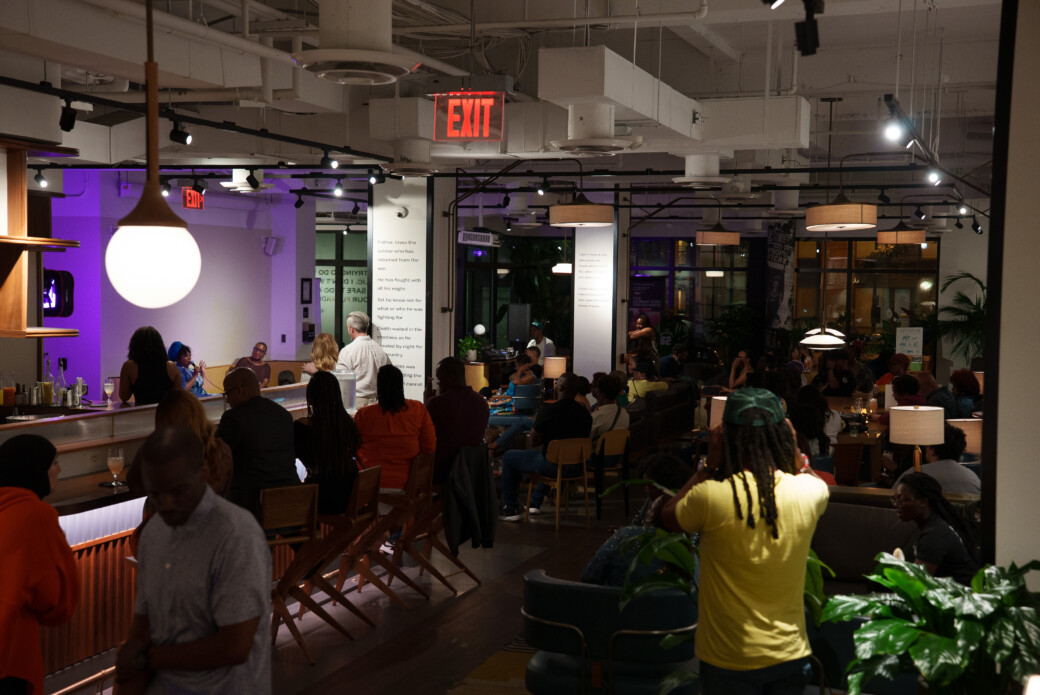
Partly as a result — and with jazz evolving in musical directions that don’t always fit neatly into standard clubs anyway — artists in the area have often found homes for the music in non-traditional, multi-use arts spaces. Among them is Eaton DC, a hotel complex just blocks from the White House that identifies as a “culture-filled sanctuary” aiming to serve the city in ways that go well beyond the building’s 209 luxury hotel rooms.
From its opening in 2018 until last year, Eaton – especially its rooftop bar, Wild Days – has been one of D.C.’s most active and diverse spaces hosting jazz, alongside dance music and other events. Early on, it helped address a need for collaborative, open-use space within the local arts community and attracted a small collective of artists across all mediums, brought in largely through word of mouth. During this time, Eaton invested heavily in multi-cultural, social justice-oriented programming through partnerships with community organizers, art installations and film screenings, book talks, panels, artist mixers, live music nights and an in-house internet radio station that platformed up and coming DJs.
But over the past few years, Eaton’s music programming, namely Wild Days’s weekly jazz nights, have largely been phased out.
While Eaton seeks to be what it calls a “cultural hub” for local artists, some who have collaborated with the hotel argue that the tension between art and commerce is preventing it from playing as supportive a role in the music as it did in its early years. Critics say they have been left grappling with the question of whether a commercial hotel such as Eaton can or should be expected to offer a sustainable home to D.C.’s creative community.
Hotel as “third space”
To achieve its sprawling vision of cultural impact, Eaton DC contains multiple components that serve various creative functions: Eaton House, a “creative coworking space;” Allegory, a literary-themed cocktail bar; Eaton Radio, the hotel’s digital media platform; Eaton Cinema; and Wild Days, a rooftop bar and lounge on Eaton’s top floor.
Eaton is among The District’s top-ranked hotels, holding a “Michelin Key” (the hotel equivalent of the “Michelin Star” for restaurants) since 2024. It is part of a movement of boutique hotels, from “micro hotels” like Hotel Hive in Foggy Bottom to The Line D.C. in Adams Morgan, that offer an alternative to the formal aesthetics of traditional luxury hotels.
“The thing that’s special to me about [Eaton] is the fact that it’s functioning as this ‘third space.’ A lot of the events are free to the community, free to artists; the coworking space is a really easy space to hang out. There’s a lot of arts-focused networking too,” said Amy K. Bormet, a D.C.-born and -based pianist, vocalist and composer who was a 2022 artist in residence at Eaton and still frequents the space. “I think that they certainly are using the capital of artists and their authenticity and their connection to the community to create a really warm vibe there.”
Eaton DC is the brainchild of Katherine Lo, daughter of billionaire hotelier Lo Ka-Shui. In 2014, Lo founded the hospitality company Eaton Workshop, eventually taking over and transforming her father’s Hong Kong Eaton Hotel — which has been open since the 1970s — into Eaton HK. In 2018, she opened Eaton DC as Eaton Workshop’s second venture.
Since its inception, Eaton DC has made a name for itself within the city’s arts ecosystem as a hub for creatives across mediums, and has tried to establish itself as a practical resource for artists who may have otherwise been working out of their homes or unable to pursue creative projects because of financial obstacles.
Other artists in residence have included musicians Dante’ Pope and Michael Bowie. Visual artists Rose Jaffe, Pete Voelker and “Rhema” Jordan Labbe, as well as theater producer Marjuan Canaday, have also held residencies. In August, Eaton launched a new “Creator Fellowship,” naming multidisciplinary, Maryland-based artist Mahkai Dominique as the inaugural fellow.
“Traditional venues like Blues Alley or Mr. Henry’s are amazing, and nothing can compare. Eaton offers more of a permeable palette. We can host a fundraiser, a job or record fair, and also music events,” Andrew Grant, Eaton’s director of music and culture, told CapitalBop via e-mail. “Within the jazz program, what we are able to do comes down to that partner and allowing them to paint [with] their own palette: acting more as a support structure and conduit, helping grassroots organizations and individuals achieve their goals.”
Bormet said that the partnership has helped to catalyze her work as an organizer on the D.C. scene. “The holistic situation of the hotel and the co-working is more of a space for people to talk, and has been a space for me to plot my next move,” she said, noting that the hotel nowadays tends to host “community-focused events that are about talking and engaging more so than a presentation or a performance.”
Eaton has become a popular event space for artists presenting their own productions, and it has hosted events in collaboration with the DC Jazz Festival, the DC Record Fair, Art All Night and various other groups (including CapitalBop, which presented the 2022 iteration of the annual Jazz & Freedom Festival at Eaton with trombonist Shannon Gunn). Allegory and Wild Days consistently host weekly vinyl DJ sets.
Live music blooms, then fades
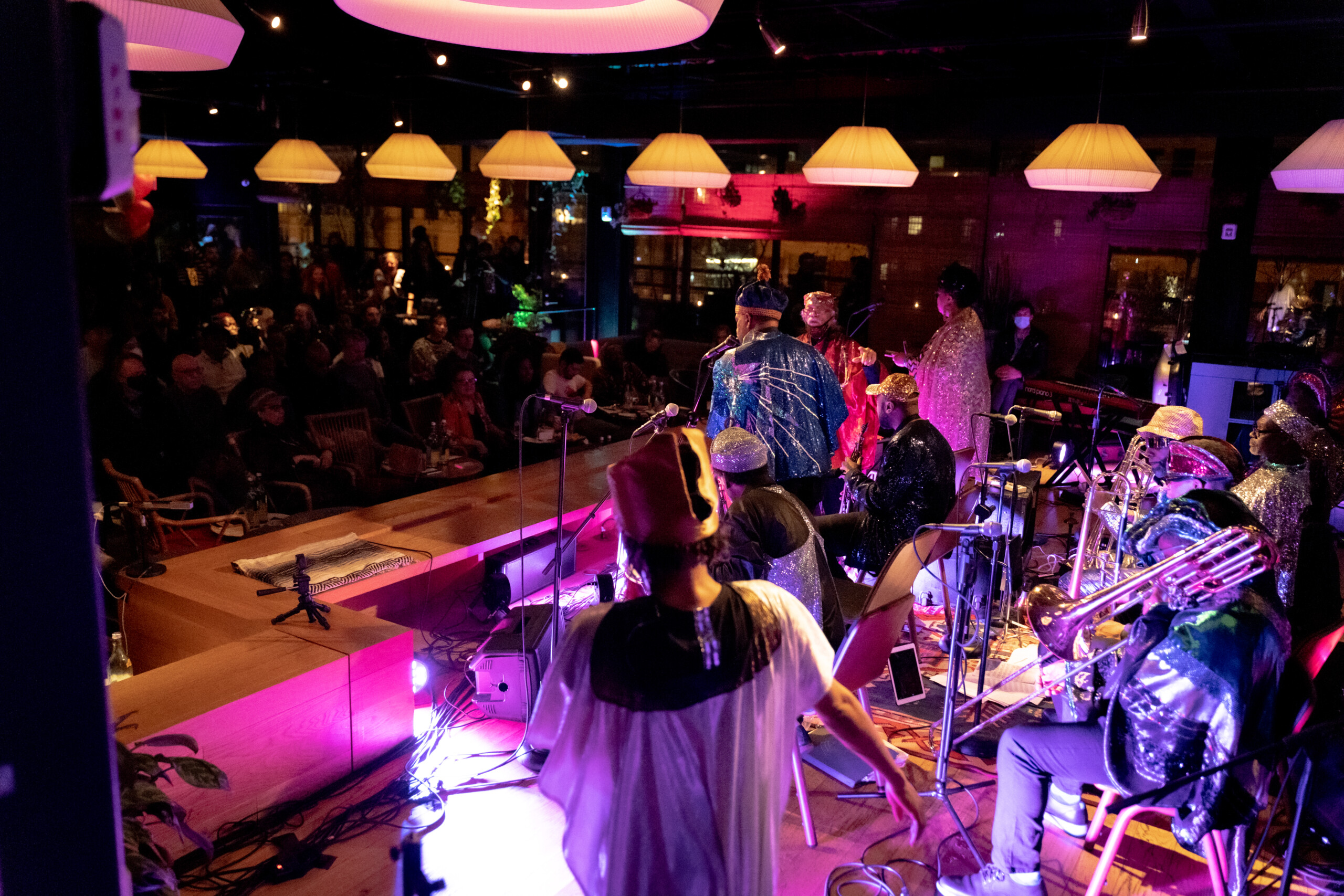
During its first few years in operation, Wild Days seemed poised to become a consistent jazz hang in D.C., with regular music programming that included both DMV-based and out-of-town artists as well as regular jam sessions. Thomas Pipkin, who describes his work as “placemaking consultancy” has for years connected local artists and musicians with businesses in the area, curated much of the live music at Wild Days starting in 2019.
“We presented a ton of great jazz, all local stuff, and also expanded and were experimenting with putting on different genres,” Pipkin said. “We had a lot of soul, R&B, female-led bands, trios, quartets and some go-go.”
Wild Days’s live jazz nights debuted in 2019, and for years featured weekly performances from DMV-based acts, all booked by Pipkin.
Early in 2024, however, the live music programming at Wild Days slowed down; it was eventually terminated in January 2025 — primarily, Pipkin said, because music-goers were not producing enough revenue for the bar. Today the space largely hosts DJ nights and private events.
“I think we were always on the edge of being canceled because the series wasn’t a huge moneymaker,” Pipkin said. “They do Friday, Saturday and Sunday local DJ-driven parties where they’re making $20,000 at the bar, [while] the jazz night contribution was $2,000. It looked really low, but in relation to other places it was still doing pretty good bar sales for a Tuesday evening downtown”
Pipkin acknowledged these struggles, but maintained that the cultural value of live music nights should have outweighed financial obstacles.
“My pitch was always: This isn’t about how much money you make at the bar for a series which cultivates, elevates and amplifies local jazz talent. This is about the associated branding with the hotel,” he said. “I will say that they did not do a good job marketing [the live music, and] I had to fight to get it on the [Wild Days website] calendar. We could’ve had more support, which I think would have brought more people out.”
Both Wild Days and Allegory bar are operated independently of Eaton’s business team, by the Mindful Management Group, an outside contractor that has been leasing the spaces since 2022. Prior to then, the spaces were run by a different contractor.
Multi-disciplinary artist Kokayi was among some of the first artists that found a creative home in Eaton, and he described a similar shift: from a sense of cultural connection to the hotel to a more distanced relationship that prioritized Eaton’s business interests. Initially brought in as a consultant, he at first found Eaton to be a space for collaboration and unrestricted creation, frequently inviting in friends and colleagues including rapper-singer Goldlink and vocalist Nick Hakim.
“It was the Blackest, freest space that you possibly could go into,” he said. “It was everybody from every cross section of marginalized people that you could think about. You had art that was being curated amazingly, you had music that was being curated amazingly, you had people that… normally would never do these collaborations with hotels in that way.”
Kokayi largely credits the hotel’s first director of culture, Sheldon Scott, with curating Eaton DC’s identity as a space where local, particularly marginalized, artists could find full creative freedom. “That was the type of thing we were trying to see, saying: Make sure that artists know that this place is here, and they can be authentically themselves, authentically Black and authentically from whatever space they would come from culturally,” he said. “You could come do that at Eaton and you don’t get the side eye, as you would get in other spaces that are not normally open to a massive influx of Black and brown people in one space without feeling all nervous.”
Turning profits — at a cost
Bormet said that Eaton’s wide-ranging and inclusive vision is largely made possible through “subsidizing the artists,” which can mean “functioning as a hotel [and] functioning as an event space to have conferences.”
Some of Eaton’s clientele for those business functions have drawn the ire of cultural partners in the local community. Most notably, the Black-led “abolitionist community defense hub” Harriet’s Wildest Dreams terminated its partnership with Eaton in 2024 after the hotel hosted events sponsored by military defense contractors like General Electric and the Aerospace Corporation. They have since continued to speak out against Eaton. Most recently, they voiced criticisms of Chef Matt Baker, owner of the hotel’s in-house restaurant Michele’s, condemning his endorsement of far-right and anti-immigrant rhetoric.
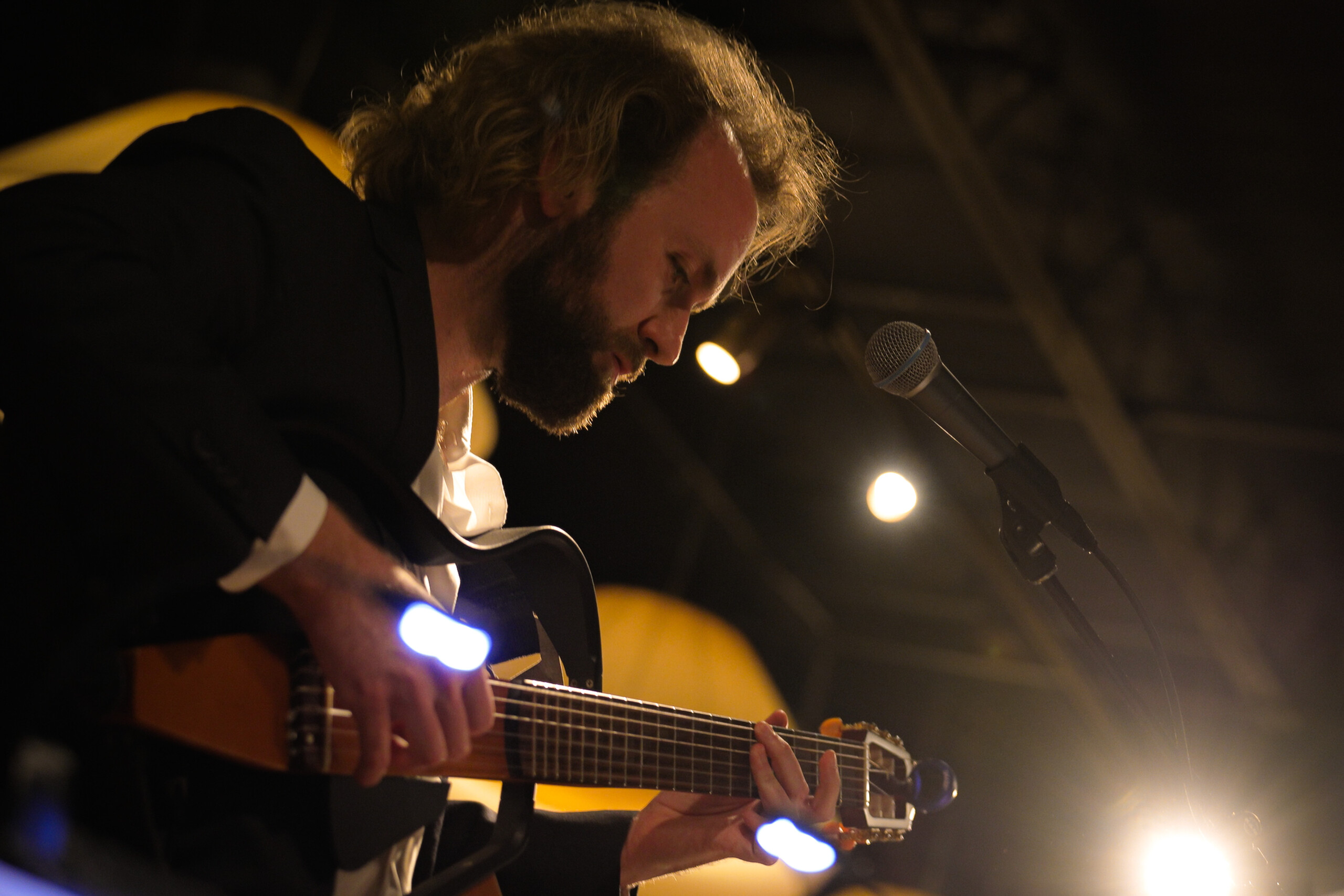
Kokayi echoed these concerns, noting a shift in priorities over the past several years that, he said, strays from Eaton DC’s initial mission. “The focus of the hotel is to make money now,” Kokayi said.
Though he acknowledged that this imperative is natural for a hotel, Kokayi lamented a diminished connection with the Black arts community in D.C. “The leading thing was about… making this a culturally safe space. But as of late, some of the moves that have happened over the last three or four years [make it seem like] it don’t really matter,” he said. “There’s still some curatorial practice going there, and the new director of culture is still putting it out there. But I feel like, me personally, just seeing how the faces have changed and the vibe has changed, [it seems] that culture is second in thought as opposed to when it was first founded.”
He acknowledged quality work being done within the hotel, led by individuals like Grant, current director culture Nina Brewton and program director Pete Danelski, rather than the institution itself. “I feel like Black art and Black work and Black people can still find space there,” he said. “The hotel is one thing. The people that are doing good cultural work are always going to do good cultural work. So yeah, I feel like the artists are accepted because the people who are doing the cultural work are making those lanes for them, just like any other institution that has a caring curator — that specifically understands underserved communities and how to embrace them — will do that.”
Some art still flourishes
Although these larger institutional changes have served to shift the culture and programs of Eaton, including a decrease in live music offerings, some artists continue to find space for themselves inside the hotel. For example, mainstay D.C. bassist Michael Bowie recently co-curated an exhibition at Eaton, “Free Music: The Illusion of Liberation,” which opened last September and ran through the end of 2025.
The exhibition, which combined music and visual arts to reveal the unseen labor and financial limitations of artists in the age of digital streaming, was a collaboration between Bowie’s nonprofit artist network Distrik Kollective, mixed-media artist Khadija Jahmila and Eaton.
“Eaton has been the best partner,” Bowie said. “They are a unique institution, and the people that they have in place… truly bleed art. There’s no double talk, there’s no promises unkept.”
In particular, Bowie said that he appreciates the creative freedom he’s awarded through Eaton, and the mix of artforms represented under its roof. “Everything goes on down there,” he said. “They are all for alleviating any boundaries and allowing you to really flourish in your ideas. I think there needs to be more spaces [like that], as opposed to dedicated [institutions]. A museum is a museum, a jazz club is a jazz club — everything is kind of boxed.”
Bowie pointed to the fact that Eaton doesn’t use genre categories for its music programming as a reflection of larger shifts in the jazz and Black music worlds, saying that this flexibility allows more diverse crowds to be exposed to Black art.
Jazz as a genre continues to expand, thanks to a new generation of leading artists like Ezra Collective and Kamasi Washington, as well as locally based musicians in a similar vein, like Brandon Woody and Foots X Coles, blending techniques of jazz and improvisational music with elements of contemporary hip-hop, house and other Black American music forms. The question arises: What types of venues best house this “new” music, which often goes beyond the parameters of traditional straight-ahead jazz? For most of its existence, Eaton has seemed invested in finding a possible answer.
“If you just create an alluring event, well curated, and people come to the space and they hear it…, it’s like, ‘Oh, I thought I would hate jazz because of all the things [I’ve heard] — maybe it’s outdated,’” Bowie said. “Most of these younger guys have moved on from where [the music] used to be.”
Bowie credits this new generation of jazz innovators with “tak[ing] the music to other avenues that have reached the people en masse.”
Today, Eaton has little in the way of specifically jazz-oriented programming. However, according to Grant, it remains committed to events that reflect the musical culture of D.C. “We have seen all ages enjoy the programming, including a younger audience. It’s important to give space and welcome all people,” Grant said via e-mail.
“Specifically, Jazz represents the truth of American art, wide and eclectic,” Grant added. “Vigorous pathways to multi genres and musical facets that stretch into Rock, Hip-Hop and Electronic Music.”