


Black Women and the Fight to Free Women and D.C.
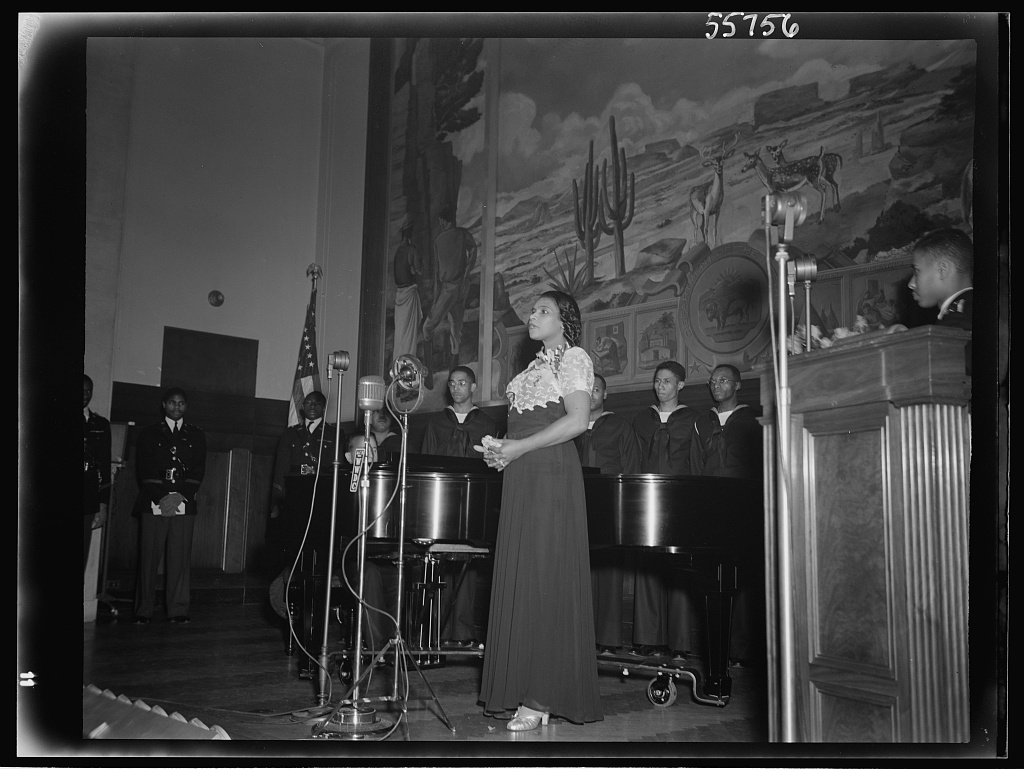
“He’s got everybody here, right in his hands. He’s got the whole world in his hands,”classical contralto star Marian Anderson sang to a record-setting crowd of at least 250,000 people on the National Mall on August 28, 1963.
In 1939, the high-profile Black singer had performed an Easter concert on the Lincoln Memorial steps after the Daughters of the American Revolution barred her from entering Washington’s segregated Constitution Hall. Nearly 25 years later, at the March on Washington for Jobs and Freedom, Anderson returned to this history-making landmark, ushering in a sound of freedom and another cry for racial equality.
Stories of resistance in Black music and performance such as Anderson’s ring throughout history, dating back to before the Civil Rights Movement. A number of these brave women artists and activists hailed from right here in D.C.
In 1890, Lillian Evans, better known by her stage name Madame Lillian Evanti,was born into a segregated Washington. Despite the racial inequality of the times, Evanti’s D.C. boasted the prime art and educational opportunities of U Street’s Black Broadway. The corridor was lined with buzzing jazz clubs, the theater stages were graced by the likes of Duke Ellington and Pearl Bailey, and schools and day camps were hosting equality advocates like the father of Black history, Carter G. Woodson, and presidential adviser Mary McLeod Bethune. U Street was the place to be.
After graduating Howard University in 1924, alongside her good friend and famed Black visual artist Alma Thomas, Evanti went on to become the first Black woman international opera singer. Her debut European opera tour granted her access to French audiences in Paris and Nice. The composer, lyricist and teacher spoke and sang at least five different languages. Upon her return to the District she helped to found the National Negro Opera Company in 1941. The company of Black talent became a safe haven and platform for artists of color during a time of oppressive racial discrimination and injustice across America.
Two years later, Evanti performed with the troupe at the Watergate barge in Northwest, attracting an audience of at least 12,000. But the significance of the two-night showcase goes beyond the large crowd and raving reviews. Evanti had accomplished a rarity in the segregated city: She performed La Traviata accompanied by an all-Black cast at the Watergate in front of a racially integrated crowd. The staging and the unity were equally epic.
Into the ‘50s, the Madame’s resilience and passion to see integrated shows and venues in D.C. is evident in archival legislative documents, showing that she lobbied Congress for the establishment of a national performing arts center that would be legally accessible to all people. Her enduring fight for a freer Washington helped lead to the 1964 groundbreaking of the John F. Kennedy Center for the Performing Arts. In its 60-plus-year history, the venue has been a reminder of Evanti’s — and so many other Black women activists’ — hidden achievements. Even if her story hasn’t been widely told, her legacy endures each time a musician, dance ensemble, neighbor, tourist or politician steps foot in the center.