Deep Groove: ‘Collaboration’
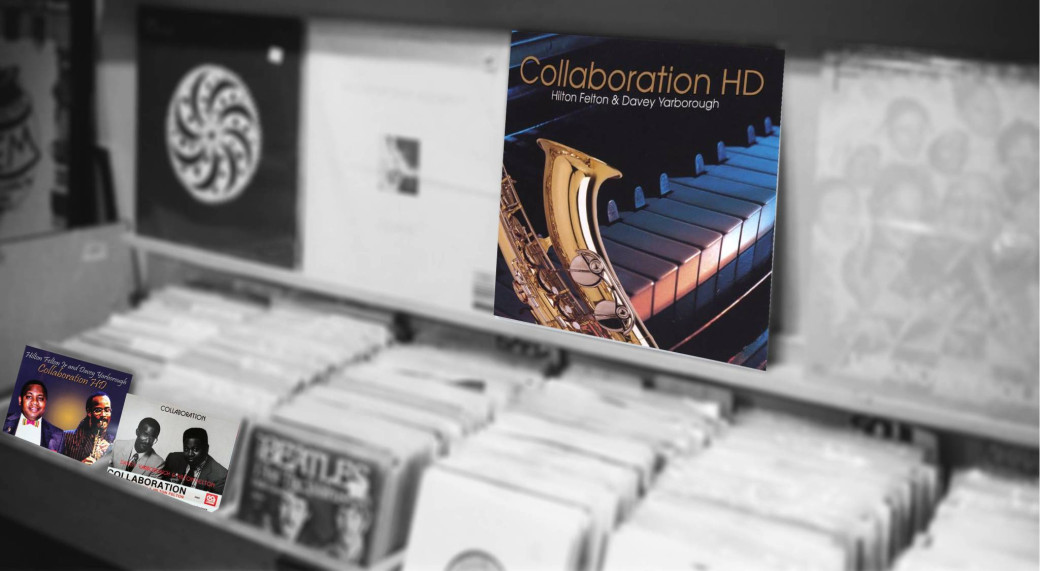
Collaboration — a recording that has been all but out of circulation in the 37 years since its release — began as something of a practical teaching moment for Davey Yarborough by his friend and close musical partner Hilton Felton. Yarborough, the former longtime director of jazz studies at the Duke Ellington School of the Arts and founder of the Washington Jazz Arts Institute, was in the early stages of his musical career and wanted to learn how to put out his own recording. Felton, an entrepreneurial funk, jazz and soul keyboardist and bandleader, had the know-how to do so.
As Yarborough recalled to CapitalBop in a recent interview, the two met in the early 1980s after the saxophonist learned of Felton’s regular solo piano night at Dupont Circle’s Mayflower Club. They soon became collaborators, with Yarborough providing saxophone and flute on Felton’s 1983 album Ode to New Life. Years later, when Yarborough expressed interest in putting out his own music as Felton did – on his indie label Hilton’s Concept – he turned to his friend.
At Felton’s suggestion, Yarbrough said, the pair picked 20 songs to possibly record, with Felton encouraging a mix of standards and originals. The duo then whittled that selection down to eight tunes and went into the studio. Weeks later, they had the cassette, which in 1989 they self-released in a limited tape-only run.
16 years later, the duo remastered the original 1989 album, reordered the songs, created new cover art and re-released it as a CD entitled Collaborations HD. (For purposes of this column, any mention of track sequencing and sound quality refers to the “HD” version).
Collaboration’s eight tunes are archetypal of both the D.C. jazz scene and the sonic palette of the late 1980s. All are duo tracks, the best of which showcase the tight interplay between Yarborough and Felton as well as the mellifluous and melodious mindset of traditional D.C. jazz musicians. Others reveal the more spontaneous and experimental strains then emerging in the music.
The album starts strong with a classic standard, “On Green Dolphin Street,” that showcases an inviting melodic sensibility. Felton and Yarborough weave in and out of each other’s playing, building a soundscape sweet with a honeysuckle-perfumed spring breeze. The lushness of the arrangement and the synchronicity between the pair calls to mind the breezy, romantic playing by pianist Bill Evans and alto saxophonist Cannonball Adderley on their 1962 album Know What I Mean?
After “Dolphin Street” and a Yarborough original called “Monk In Blue” (which has an absolute tongue-twister of a head melody), Felton swaps the piano for some kind of synthesized organ — imagine the SNL “Church Lady’s” organ watered down. The duo then plays three ballads: the spiritual “Deep Water,” “Nancy with the Laughing Face” (listed as “Nancy with the Smiling Face”), and “Esther,” which Yarborough wrote for his wife. Although the synthesized organ feels dated to the sonic palette of the late 1980s, Yarborough’s emotional styling feels timeless. Indeed, on “Esther,” there is the kind of airy romance of a Coleman Hawkins that hangs off of every note from the tenor saxophone, conjuring that “Body and Soul” spirit.
The duo’s playful essence and their joyous celebration of melody returns on a jaunty version of “Tomorrow” from the musical Annie. Yarborough’s soprano saxophone spouts sunshine from the bell as Felton bangs out bass-heavy chords that practically skip and hop-scotch along the piano keys. “Tomorrow” served as the original closer on the 1989 cassette, and it is easy to see why.
However, on the CD release, following a noir-ish tribute to Yarborough’s daughter, “Davie Celeste,” the pair end on Burt Bacharach’s “You’ll Never Get To Heaven.” There is the same relaxed, unhurried feel here as on many of the other standards performed on the album. Rather than suggesting a kind of unserious approach to playing, however, the airy, enveloping performance allows the listener to be gently swept away into a delightful pastoral soundscape.
“He liked the way I played, and I loved the way he played,” Yarborough recalled of Felton to CapitalBop during a 2023 phone interview. “We got real tight.”
When he looks back on Collaborations now, Yarborough thinks of “so much fun he and I had” and “the adventures. We had all kinds of adventures.”
While the 1989 cassette is out of print and rarely available via the secondhand market, the Collaborations HD CD can be purchased directly from Davey Yarborough by contacting him via his online website. Limited copies can also be purchased at HR Records, which confirmed availability at time of publication.
–
This is the third article in a recurring series, Deep Groove, in which writers take a close listen to significant but especially rare and out-of-print albums from D.C. jazz history.