Leigh Pilzer on what ‘keep holding on’ really means to her
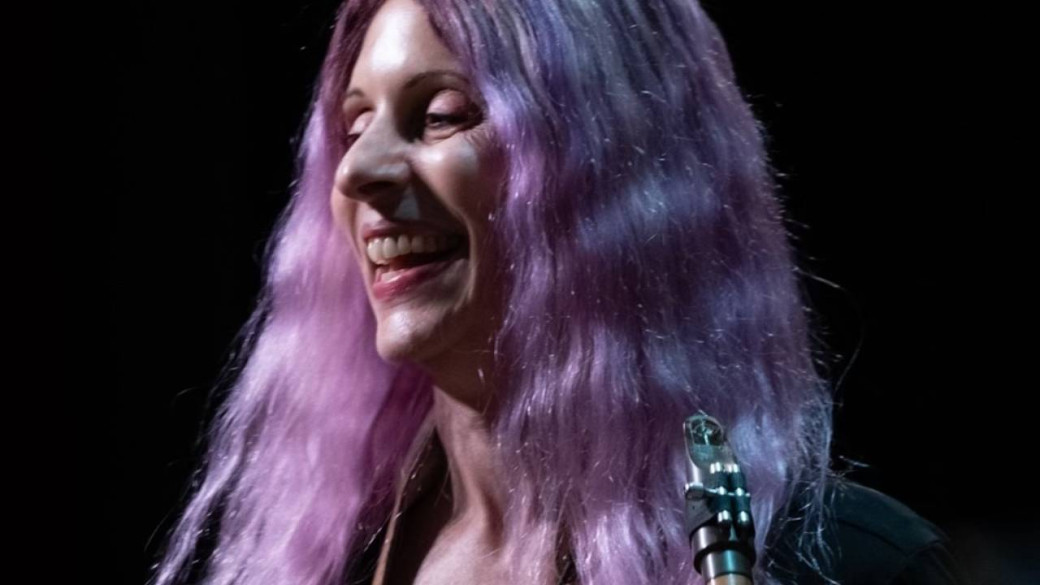
“You might ask yourself, what can one person do?”
This is the proposition Dr. Billy Taylor put forth in his song, “If You Really Are Concerned,” the final movement of his Dr. Martin Luther King Jr.-inspired “Peaceful Warrior” suite. Though written nearly six decades ago, those words and music still hold relevance, and were on the mind of baritone saxophonist and composer Leigh Pilzer last year as the “monolithic, steamroller” actions of the second Trump administration swept across the United States.
What Pilzer could do, she decided, was write music to give people something to hold on to, “and have faith that it’s going to come around again.” This feeling has been expressed before in this publication, when the great sage Wayne Shorter said 10 years ago that jazz can provide “something constant that can be relied on when a lot of things historically are re-written and moved around.”
That impulse toward the steadfast manifested in the title track of Keep Holding On, Pilzer’s grooving new organ trio record, out June 19 via Strange Woman Records. The band is made up of Pilzer, organist Paul Bratcher (on a genuine Hammond B3) and drummer Greg Holloway, and features frequent collaborators like trombonist Jen Krupa as well as trumpeters Kenny Rittenhouse and Ally Hany Albrecht.
Although the urge to Keep Holding On began with political overtones, the message also took on pointed significance recently: after entering remission nine years ago, Pilzer’s ovarian cancer has returned.
However, when Pilzer sat with CapitalBop on June 12 to discuss the new record, she emphasized that the music is about so much more than simply being a person living with the realities of cancer — it is about celebrating life through music, and even a little humor. Over the course of the conversation, Pilzer focused on her dynamic musical journey, one that has led to her current status as a celebrated maestra of the baritone sax and a sharp, prolific composer and arranger.
This interview has been edited for length and clarity.
CapitalBop: You grew up in a somewhat musical household in Montgomery County, Md. playing classical piano, so what got you into jazz?
Leigh Pilzer: It was really when I heard the Count Basie band.
Bill Potts, who lived here — an arranger, composer and pianist… who wrote for Woody Herman’s band and Buddy Rich and some folks — was working out at Montgomery College, and there were a few of us that he kind of took under his wing. Ron Horton was one, Chuck and Robert Redd and Paul Langosch, too. [Potts] would take us down to hear the military bands. I thought that the Airmen of Note — with all the woodwinds — was the coolest, and I [also] thought Toshiko Akiyoshi’s band was very cool, because she had all the woodwinds. But then [Potts] took me to hear Basie, and it was like, “Bam!” — the sense of swing and the band dynamics, the way the Basie band just pivots on a dime, you know?
So, I was like, “I want to do that!” I’d been playing piano in the high school big band; I’m not feeling it. I want to do something different, and of course, bass would have made sense, but since when do we make sense? I considered trumpet and saxophone. I don’t know why I didn’t consider trombone. It just sort of didn’t register. I think I’d have been a great trombone player; I’d have been a great bass trombone player. … I thought “I’ll play saxophone,” because I thought trumpet would hurt too much. I started on alto saxophone, which was fine. But then, I was going to Montgomery College, and Chuck Redd was in the big band, and the baritone player couldn’t make a gig. Chuck says, “Leigh plays saxophone now, get her to do it.”
I’d been playing saxophone like six months or something. They handed me the school baritone — they had a nice, low B flat Selmer — and I was like, “Oh, this is the sound.”
CB: How else does that “eureka!” moment with the Basie band inform how you approach your art today?
LP: I think I have a very ensemble-based concept. So even in front of a quartet — my own quartet — I don’t see it as “me” and “the quartet.” I’m just as likely to comp, to play a bass line, to play whole notes, to do something to be involved behind a piano or bass solo, or even a drum solo, because it isn’t me as an entity, and the rest of the band as an entity. … I think very ensemble-like, and that’s what the previous CD, Beatin’ The Odds, was about. It wasn’t about me as a player in the front. It was about the sound of the ensemble.
CB: Speaking of ensembles, you’re well known for your association with larger groups, whether it’s Seven-Pointed Star or the Smithsonian Jazz Masterworks Orchestra or the DIVA Orchestra. Why did you go with a smaller combo on this album?
LP: I’m going to go back to 2011, when Amy K. Bormet started the Washington Women in Jazz Festival. She announced, “Okay, so you’re gonna curate a set at Twins.” Then every year she’s like, “What do you want to do this year?” So, there were times that evolved into maybe just me with a rhythm section. One year we did a thing with just me and Amy and Karine Chapdelaine. … So, through Amy and the festival, I was involved with groups of different sizes
The first time I played with Paul on his organ setup was in 2019 and we did a gig at JoJo and I had Frank Russo on drums, and I had Kenny Rittenhouse come in and play. So that was the group, and it was so much fun, and I just thought, “this is my project moving forward, this band.” As it happened, I was supposed to have been playing at Takoma Station on March 28, 2020 and I was going to take that band in, and…
CB: We all know what happened.
LP: So I kind of forgot about [the small group], because I got involved with the seven piece, because that was something I cooked up during lockdown.
In 2023 maybe, I played up at Wesley Church and I had Paul on that with me, and I had Greg Holloway, and it was so much fun. And I was like, “Oh, right! I love this! Yeah, I need to do this more.”
By listening to how rhythm sections will respond, and if you open yourselves to them, it becomes a conversation, and you’re creating it together. It’s more fun. It’s more creative. It’s more musical.
CB: What makes the group so much fun?
LP: Everybody listens and everybody reacts and interacts. … That’s something that I learned from Jen [Krupa], because she loves collaborative improvisation. So, she brought that idea to the table when we started playing together, and I realized we’d be playing at the same time, which is not the same as collaborating. By doing that, I sort of learned how to listen and play at the same time, which is a great process, because I think, as horn players, we get very much in that “the rhythm section is a play-along.” I think it’s too easy for horn players not to listen.
By listening to how rhythm sections will respond, and if you open yourselves to them, it becomes a conversation, and you’re creating it together. It’s more fun. It’s more creative. It’s more musical.
CB: What did you have in mind with the title of this newest record, Keep Holding On?
LP: I was driving, I think, to a gig, and I was listening to a Billy Taylor small group recording, his “Peaceful Warrior” suite. One of the movements is called “If You Really Are Concerned,” and he has Grady Tate sing it, which is as charming as can be. So, I’m driving along [and I hear him sing], “If you really are concerned, then show it. Express your point of view, take a stand.”
I’m driving along, just feeling like the smallest creature on the planet, because I’m not down there with a sign, and I’m not down there shouting. We get to the bridge, and he says “You might ask yourself, what can one person do?” I’m like, “Well, I can write music.” And then, [Pilzer sings,] “Each person has something special to give, and no one can give it but you.” There’s my message from Billy Taylor. So I thought, “You know what? We got to just keep hanging in there.” You can hold on and have faith that it’s going to come around again. …
And it can be read for into other situations as well. So, on Beatin’ the Odds, there are five tunes that have to do with my experience having had cancer, which is not a journey, and it’s not a battle. I’m not a survivor, and I’m not a warrior. I’m just me living my life. And there are a couple songs on this CD, “Musing Music” and “When It’s Gone,” that have to do also in certain ways with having had cancer. …
But back by unpopular demand, coming to a baritone saxophonist near you, I’m just about to head back into treatment. It’s been nine years, so I just keep reminding myself, keep holding on, because you know what? You’re going to make it through this.
CB: How much do you want to talk about that?
LP: I mean, it’s my life. … For years I didn’t [want to talk about it]. I didn’t want to be “that girl with cancer.” … I feel like once someone knows that you have cancer, what they look at and see is the poison symbol of a skull and crossbones, and they don’t see you. … I’m going to, I’m going to give Elijah [Jamal Balbed]’s mom some credit for this — [Maryam] “Skater Mom” Balbed — because she posted that we’ve got to normalize this, and I think she was absolutely right.
This is why I don’t like “survivor,” because it’s very binary, you know? And “battle” — if it comes back, what does that mean? That you were like a wimp, and you’re not a warrior? No. Statistically speaking, I should not have survived this long. So, this is pretty remarkable. My sister died of the same cancer — ovarian — and she made it three and a half years, and I’ve made it nine. Treatment modalities are changing, so we’re now looking at treating cancer as a chronic condition.
I’m working on a project — we’re just starting to put it together — with pianist Monika Herzig and a bass player named Bethany Robinson, and both of them have had cancer. We were talking at the Jazz Education Network Conference in January, and I said, “Hey, you guys, I’ve had this idea in mind. What if we were to put a project together and play music and be in people’s faces, saying ‘It’s not a death sentence?’” …
Monika has stories about nosebleeds on stage, because she was gigging while she was in chemotherapy — like what if we put that together and put it out there?
I was joking with Monika and Bethany, [that] I really want to call this project, “But You’re Fine Now?” and that I really want to release a recording called “Yeah.” Except people aren’t going to get it, so we applied to perform at the Jazz Education Network Conference, and much as I hate “survivor,” “warrior,” all of that, I did title the project, “But You’re Fine Now: Songs from Cancer Survivors,” because you’ve got to give people the context.