‘I Remember Miles’: elders recall a ‘special relationship’ between Miles Davis and D.C.
In a career spanning nearly 50 years, Miles Dewey Davis helped guide many of the major evolutions in jazz music. A pioneer of the cool-jazz, hard-bop, modal and fusion styles, he later pushed boundaries with his explorations of hip-hop alongside producer Easy Mo Bee, right up until his death in 1991.
Less well-known is the fact that, in those final years, Davis was also exploring the contemporary sounds of Washington, D.C. Ricky “Sugar Foot” Wellman, a major figure on the go-go scene here, became Davis’s regular drummer from 1987 to 1991 (Davis was one of many national figures taking an interest in the new musical style known as go-go during that time).
Indeed, D.C. and Miles Davis — who would have turned 100 this week — enjoyed a special relationship throughout his career. In the years when Davis was making his biggest creative waves — the 1950s to the ‘80s — the nation’s capital was a cultural Mecca for Black America. And many who lived through that era, when they think back to it, are quick to recall Davis’s appearances on stages across D.C.
Davis performed in the District at various times throughout his career, including a 1958 show at the historic Spotlite Lounge, a 1970 run at The Cellar Door (where he recorded his albums Live-Evil and Live at the Cellar Door), and concert appearances in the 1980s at the Warner Theater, the Kennedy Center and the Capital City Jazz Festival.
In anticipation of Davis’s 100th birthday on May 26, CapitalBop asked musicians, writers and fans from across the D.C. jazz scene to reflect on his lasting impact — on their lives, and the fabric of contemporary Black music.
Born on May 26, 1926 in Alton, Ill., Davis moved to East St. Louis as a child, where he began playing trumpet at age 13. While still in high school, he joined Eddie Randle’s Blue Devils band, marking the beginning of his professional performance career.
In 1944, he moved to New York City, cutting his teeth in the big bands of famed leaders Dizzy Gillespie and Billy Eckstine and spending his nights at small clubs in the city’s Harlem and West Village neighborhoods, where he was drawn to the emerging bebop sound. It was here that he connected with saxophonist Charlie Parker, an architect of this new music, who took Davis under his wing as a mentee and musical collaborator.
For A.B. Spellman, the legendary D.C.-based poet and jazz critic, Parker was the bridge to discovering Davis.
“A friend of mine had some Miles Davis with Charlie Parker on an old 78. Bird is the one who caught my ear more than Miles, but I do remember Miles’ solos were very coherent and contemporary. They were full of features of bebop music at the time,” Spellman said. “You can’t overestimate the importance of Miles’ sound. There’s nothing like it. Not many people have what Miles had, which is conception, discipline and sound. And put it all together and surround yourself with people who can enhance that for you.”
Davis’s first significant innovation as a solo artist came with the birth of cool jazz, a West Coast-dominated movement that offered a more reserved and regimented counter to the raw, hard-driving approach of bebop. A native of Elizabeth City, N.C., and a Howard University graduate, Spellman moved to New York City in 1957 — the year Davis released The Birth of the Cool — and immersed himself in the city’s jazz scene.
“His Birth of [the] Cool record was a pivotal point for jazz because it broke off from the bebop movement and got into a different sound, which recognized that the music was no longer catering to dance and therefore dance rhythms were no longer relevant,” Spellman said. “It was entirely going to be a listener’s music. It had an attitude toward playing that de-emphasized the heat of the swing period and emphasized a more cerebral approach to playing music, looking to expand possibilities and look into areas that hadn’t been so exploited by jazz before.”
In the decade following, Davis went on to establish himself as a preeminent bandleader, and helped mold hard bop and modal jazz. Spellman’s first encounter with Davis onstage included a version of the band that would soon change history with Kind of Blue.
“The first time I saw Miles live was in New York at a club off 7th Street in the Village. His band had Cannonball Adderley and John Coltrane. That was mind-expanding, largely because of Trane and Cannonball — because, as a pair, they were so fluent on the instruments and striking conceptions,” Spellman said. “Miles was more of a listening musician. You had to be somebody who knew how to listen, be quiet, clear your mind and listen to music without distraction to appreciate how good Miles was. He didn’t go outside of a rather limited range. He didn’t hit the high notes that caught everybody’s attention. You had to pay attention to what the musician was actually saying.”
Davis’s novelty lay not only in his stylistic innovations and steady, lyrical sound, but in his ability to spot new trends and talent. His bands were often incubators for up-and-coming musicians, constantly pushing the genre forward.
“You got into the hard-bop sound, which managed to incorporate a certain amount of bluesiness [in]to it. And Miles was right on top of that and led one of the greatest, if not the greatest, small ensembles of the period: the Kind of Blue band,” Spellman explained — a group that included D.C. native Jimmy Cobb on drums. “Miles always surrounds himself with the best musicians. He surrounded himself with Coltrane and Adderley, Paul Chambers. These were the very best musicians at their stations. It certainly facilitated a growth in Coltrane at a key period of his development. Coltrane made himself a genius. He was a middle-of-the-road hard bop tenor saxophonist, but Miles heard his potential.”
D.C.-area drummer and bandleader Nasar Abadey became a regular listener to Davis at age 15, in the early 1960s, as Davis explored the modal jazz movement’s more freeform melodic expressions. “When John Coltrane was in his band, that’s when the modal movement started. I noticed many of the musicians that came out of Miles’ band went in that direction,” Abadey said. “It is, harmonically speaking, a more open approach to composition and improvisation.”
Soon after, Abadey became fascinated by the technique of drummer Tony Williams, a member of Davis’s “second great quintet” with Wayne Shorter, Herbie Hancock and Ron Carter.
“When I first saw Miles, it was at a time when he was moving away from the American Songbook and he started moving into more of an in-your-face approach. He had young musicians in their 20s, but Miles was in his 30s. He surrounded himself with young musicians who were influenced by the music of the day, so there was more free expression and avant-gardism,” Abadey said. “Wayne Shorter’s writing always presented new opportunities and new juxtapositions of harmonic concepts. Miles explored that, and the music of Herbie Hancock, who was a master chordsman. Miles liked to play in an environment where he’s taking chances, and it encouraged other musicians who played around him to take chances.”
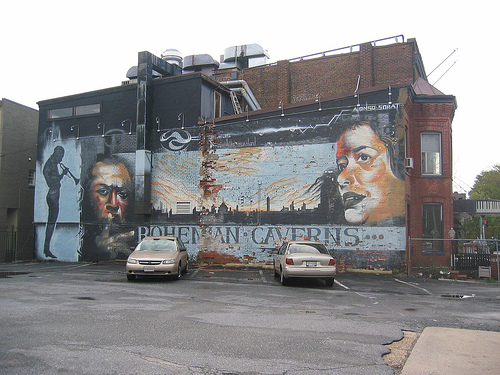
In 1965, Davis and his quintet returned to D.C., taking the stage at the famed Bohemian Caverns, a central fixture in the local jazz scene for nearly a century. Prominent D.C. jazz radio personality Rusty Hassan was in attendance, and remembered the show fondly. He recalled the Caverns’ role as a hotspot for major talents coming through the city.

“It was an integrated crowd: primarily Afro-American, but white folks felt very comfortable going there. It was the jazz spot to see major artists,” Hassan said. “Tony Taylor, who was really significant for the jazz scene in Washington, even after the Caverns closed — he was the one who ran the club.”
Davis’s stylistic growth coincided with political tensions at the time, Abadey said. Although Davis was not necessarily a traditional activist, his experiences with racism and police brutality ignited a quiet resistance within him, and he channeled his frustration into sonic expression.
“The Vietnam War, civil rights, riots and the assassinations of Martin Luther King Jr. and John F. Kennedy. The music was all a reflection of that. That started Miles thinking about music with electric instruments, like electric piano and bass. That band was the creator of what we refer to now as fusion. Tony Wiliams is the creator of fusion drumming, which is drumming fused with the beat of straight eighth notes and backbeats,” Abadey said. “Miles changed his dress and his way of playing the music, which was very aggressive and assertive. Many people who loved Miles in the ‘50s and early ‘60s did not like that change, and the fact that he wasn’t wearing tailored three-piece silk suits anymore. Miles was going out listening to Sly and the Family Stone. If you listen to his fusion period, with Jack DeJohnette and Chick Corea, there were times when, after Miles played a solo and Wayne Shorter’s solo came about, Miles was standing in the back holding his horn, watching the band go off into freedom. It was remarkable to watch that happen.”
After the second great quintet, Davis worked to bridge jazz with rock and funk, helping develop the fusion subgenre, and drawing in a younger generation of fans who would come of age in the 1970s and ‘80s. One of those was the Baltimore-based trumpeter Dave Ballou.
“I only saw him play one time. I think I was about 19 years old. I think it was 1982. He was doing the comeback thing, and so he was playing at the Newport Jazz Festival. It was the band with [John] Scofield and Bob Berg. I wasn’t that close to the stage, but I was just mesmerized,” Ballou said. “I saw him playing a trumpet, but the way he played the trumpet and his whole presence, was like he was transcending the instrument.”
Davis became a model for Ballou’s artistic development, as he learned to play jazz trumpet through listening to and transcribing Davis’s music.
“I think he’s an example of how an artist should be in the world. You’re always evolving,” Ballou said. “He didn’t want to go back and play stuff he did ten years earlier. The way he plays time and phrases over bar lines is incredibly sophisticated. He can play the form of a song but not in the most obvious way. That’s, to me, the height of improvisation. Miles had just as much technique as anybody, and you can hear him ripping lines like the great technicians did. His main contribution is that you use the trumpet as your voice, it’s not a display of technique, because we trumpet players get wrapped up in the technique of the horn, high notes and fast and all that.”
The end of Davis’s career was marked by a more pop-influenced, tamer sound. After going on hiatus from 1975 to 1980, he began touring again in 1981 with his album The Man with the Horn.
Pierre Tourellie, a longtime concert taper and fan of Davis, attended the trumpeter’s 1981 show at the Warner Theater, as well as his 1982 Kool Jazz Festival performance at the Kennedy Center.
“The Warner Theater was a little bit more intimate. There was an air of excitement. Nobody had seen Miles Davis in concert since 1975. The performances were pretty sharp. It was a new band: Marcus Miller, Mike Stern, Al Foster. Everybody’s attention was focused on that band in that huge theater. Before his retirement, everybody was wondering, ‘How could he go beyond where he’s already gone? What’s the next chapter of this great story?’” Tourellie said. “My sense is that, in ‘81, he was more connected with his audiences in a way – more aware of them, less confrontational. He was always magic to watch. He moved like a prize fighter the way he walked around the stage very carefully. I don’t think he was doing that just to affect the crowd, I think he was an extension of the music.”
Of all Davis’s ties to D.C., perhaps none was stronger than his friendship with Shirley Horn. She was discovered by Davis in 1960 after he heard her debut album, Embers and Ashes, and insisted she open for him at the Village Vanguard, saying he wouldn’t play without her. Additionally, Horn closely mentored drummer Billy Hart, who went onto play for Davis in the early ‘70s.
“Miles had a good relationship with D.C., [and] that special relationship he had with Shirley Horn, that connection was really important. The fact that he insisted that she open for him at the Village Vanguard was really significant in her career,” Hassan said. “But then the fact that he actually soloed on that recording [“You Won’t Forget Me,” from 1991]. The affection that he had for her, and she had for him — it was absolutely one of the great connections.” She would pay tribute to Davis after his death, on the 1998 album I Remember Miles.
But as encouraging as he was toward Horn, Davis was known to be unapologetically violent toward other women in his life, including his wives. In his 1989 autobiography, written with Quincy Troupe, he describes his own abusive behavior without apparent remorse. The next year, author Pearl Cleage published Mad at Miles: A Black Woman’s Guide to Truth, detailing and grappling with her own response to Davis’s violent behavior. In the book, she remembers A.B. and his wife Karen Spellman turning her on to Kind of Blue at their house in D.C. years earlier (“the truth is, this is all my friend A.B.’s fault,” she writes jokingly), then ruminates on Davis’s history, broader dynamics between Black men and women, and issues of sexism, racism and domestic and sexual violence. Today, some 36 years after Mad at Miles came out, Davis’s history of abuse toward women is still often omitted from discussions of his legacy.
In 1985, he made an appearance at the Capital City Jazz Festival, having been booked by local organizer Karen Spellman and jazz journalist and presenter Bill Brower. “She was worried about: ‘Miles is coming, he’s supposed to be this evil person!’” A.B. Spellman remembered of his wife. “But she said when he came in, he was very sweet, very nice and easy to talk to, and wanted to accommodate her.”
Davis’s legacy will never not be complicated. His own internal complexity came out sometimes in harmful behavior, and at others in music that will forever impact the world. That includes albums recorded live in the nation’s capital, and some brilliant moments that listeners here have never forgotten.