Jack Kilby on a decade of Crab Shack, Del Ray’s ‘home studio’
From the outside, 211 E. Oxford Ave. in Alexandria, Va. seems like simply another Craftsman home lining the streets of the city’s leafy Del Ray neighborhood. However, as soon as the doors are opened, visitors know the house is so much more.
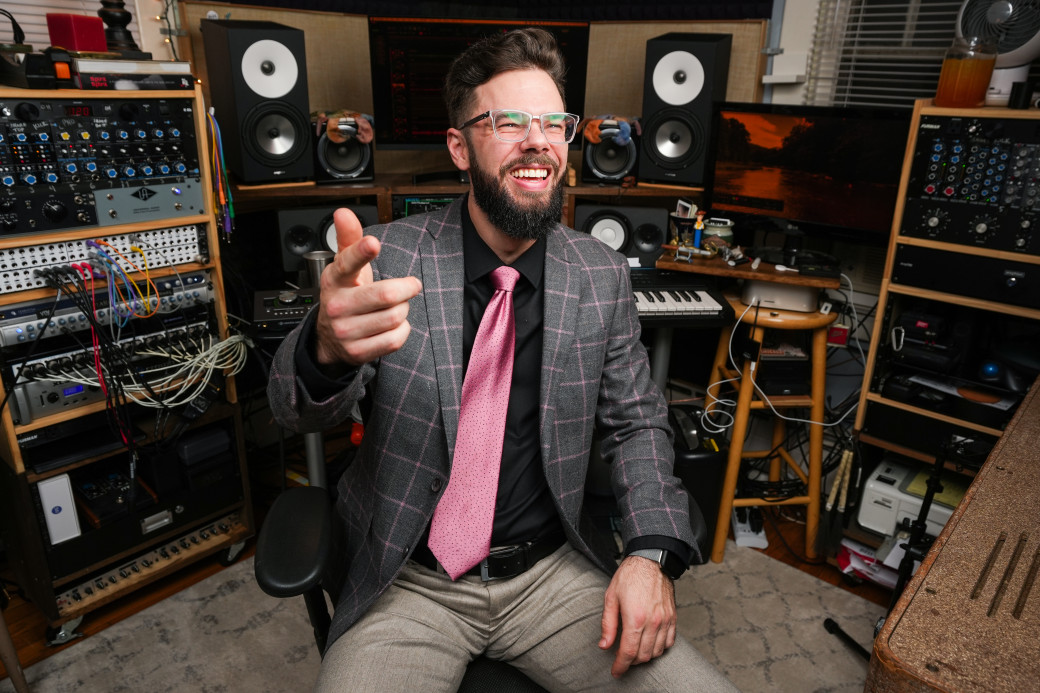
Immediately, guests are greeted by a full studio in the living room. Guitars hang from stands on the floor and the walls, keyboards are set up along the perimeter and a drum kit sits across from the entrance, ready to be played. The adjacent room’s walls are painted with blue waves, and sea creature stuffed animals are stacked above the entrance to the kitchen. The lingering smell of incense sweetens the atmosphere. The recording studio, filled with equipment lent from friends and purchased secondhand, feels both cozy and professional.
This colorful and homey studio is Crab Shack Music, a production and recording studio, private lesson space and occasional concert venue that this year marks its 10th anniversary. Founder Jack Kilby — who, in addition to his work running Crab Shack, is also an accomplished drummer — has worked over that span to curate the studio’s intimate vibe, aiming to create a space that is comfortable and relaxing enough for creativity to flow, with a production process honest and sharp enough to make the end result as high-quality as possible.
Over the years, that approach has resulted in numerous notable releases, such as ¡Fiasco!’s Arson and Post-Truth (each of which CapitalBop named D.C.’s top jazz album in their respective release years).
On June 12, Crab Shack will celebrate 10 years of creating a local, accessible home for music-making with this year’s version of “Crab Shack Live,” the studio’s annual backyard concert series. In addition to hosting live performances from artists like rising saxophonist Langston Hughes II and R&B legend Sy Smith, the event will also serve as a launch celebration for the studio’s in-house label with the release of Crab Shack Live, Vol. 1: Hot Mess Trio, a live recording from the 2023 iteration of the concert.
Ahead of the show, CapitalBop sat down with Kilby to reflect on the studio’s history, the culture and community it has cultivated, and what the future might hold.
This interview has been edited for length and clarity.
CapitalBop: What led you to open Crab Shack?
Jack Kilby: [After finishing grad school at Queen’s College] I knew what I needed in a space — namely, a place to play drums. I got here at the end of 2015, and started substitute teaching and teaching lessons, and then I found this house through my then-next door neighbor. I came to peek through the window, and it was empty, and I looked into that living room, and I just couldn’t help but think, “Yeah, this is gonna work.”
It’s been a slow process of transforming it into what it is now, [but I’ve had] the opportunity to grow the space here and hopefully fill a need, too, for musicians, so that they can get a professional quality recording without having to pay an arm and a leg for it.
CB: Crab Shack supports both professional and student musicians. How does it cater to both communities?
JK: I do love working with kids and watching them improve, and being able to be an unbiased voice in their life — someone who’s going to tell them the hard thing that their teacher or their parent can’t or isn’t ready to tell them.
The professionals that come here see the space and they really dig it, and they feel really comfortable here. The recording process is 110 percent about the artist being comfortable, being able to give the best performance of their music that they can.
There’s no plug in for heart. I can fix your tuning, I can fix your timing, but I cannot give you more emotion or heart or pain, whatever it is that you’re trying to do to bring it out. The more comfortable [musicians] feel, the better chance you’re going to get a result that they want.
CB: You are also a musician yourself. How has Crab Shack fit into your holistic professional life in a way that makes you satisfied?
JK: Now that I’ve gotten to sit in the engineer chair, I [have] more of a well-rounded view of what makes a good performance, I think. Any musician is so worried about their ability on their instrument and how that’s going to come through, and I’m just really starting to appreciate that. Sure, I mean, ability has value, but it’s really the personality of your sound that I think matters the most. How are you going to convey that emotion and make someone feel something?
CB: What led you to start hosting live shows at Crab Shack?
JK: It came down to, again, having the space. I’ve got a big yard in the back, and the first one I did here was in September 2016, shortly after I moved in. It was with four bands that I was playing with at the time, including my own, and it was very humble, but it was fun.
After the pandemic, I was realizing how much [the pandemic] did inspire a lot of creativity in musicians and artists. So I was like, okay, if these are our limitations, especially in the lockdown, how can I still get my music out to people, or be present? For me, I kind of took that a step further: “How can I wipe the slate clean — what does presenting music even look like?”
There’s no plug in for heart.
CB: What niche has Crab Shack filled for the DMV’s jazz community?
JK: I think somewhere where there’s that comfortable space to get a high-quality recording that’s not going to break their budget.
Hopefully musicians just appreciate coming here. The [gear] that I’ve been able to acquire, the knowledge that I’ve got, trying to help them without stepping on their toes because it’s just my job to press the red button — they didn’t hire me to necessarily produce their record, but I’m also not going to not speak up if it is something that is in service of the music.
CB: Looking 10 years into the future, what do you hope to see from Crab Shack?
JK: It’ll be interesting to see if we’re still here. I’ve been on a month-to-month lease at this point for nine years. My landlord has threatened to sell the house, not because he doesn’t like me, just because he isn’t sure what he wants to do with the house. I’m not sure if I’ll be able to afford buying it, to be honest with you, because it’s such a high-quality neighborhood. Plots around here go for crazy prices, plus, this house would need a lot of work — it’s only got one bathroom, the foundation of this house has been underwater several times. Even if I could afford it, I don’t think I’d be able to afford the work it would need.
I hope I’m still doing what I’m doing in 10 years, but if not, I’ve kind of accepted that I’m just gonna run with this chapter for as long as I can: Keep doing the live shows, trying to record people, keep working with young people, hopefully get out a record of my own within the next 10 years, that would be a goal of my own to have.